






By Glenah Nyamwaya
Disturbing global statistics have revealed that Chronic Kidney Disease (CKD) is the 8th leading cause of death among women worldwide with over 600,000 women dying each year and approximately 195 million women affected by the disease annually.
The 8th of March 2018, marked an important day for women as Kenya joined the rest of the world in commemorating the International Women’s Day and the World Kidney Day (WKD). This year’s theme focused on Kidneys and Women’s Health. Experts now confirm that women are at a higher risk of developing chronic kidney disease as compared to men.
During celebrations to mark WKD 2018 held at Kenyatta National Hospital (KNH), Chairman of the Kenya Renal Association (KRA) Dr. Ahmed Twahir, emphasized on the need for creating more awareness thus causing a positive impact on kidney diseases globally. “This is a global awareness campaign and we ought to use it to save patients with kidney related diseases,” said Twahir.
Speaking to Health Business,Dr. John Ngigi, head of the Nephrology unit at Kenyatta National Hospital, noted the need to increase awareness and education to facilitate women’s access to treatment and better health outcomes as pertains CKD. “Data from the KNH transplant cohort from 2010 shows that the middle age groups (25-45 years) are more affected than other groups and mainly for chronic glomerulonephritis (sequel of infection) and hypertension. Older age groups suffer more from hypertension and diabetes respectively” said Dr. Ngigi.
He however added that lack of renal registries makes it difficult to understand Kidney disease epidemiology and management outcomes in many developing countries that often rely on studies done elsewhere. “It is however generally accepted that 10 per cent of any given population suffer chronic kidney disease. Between 4and 4.5 million Kenyans have Chronic Kidney Disease and will subsequently need renal replacement therapy.
It is a bit more difficult to be as precise on the prevalence of acute kidney injury given its variable and unpredictable epidemiology,” Dr. Ngigi noted. Kenya however lacks a renal registry that can give proper epidemiology of CKD but the KRA in conjunction with the East African Kidney Institute are independently at advanced stages of establishing a local renal registry.
Data obtained will not only help in identifying the pattern of kidney diseases but also the risk factors and the treatment outcomes done locally. CKD has been termed as a worldwide public health challenge with often fatal outcomes of kidney failure and premature death. It is described as gradual loss of kidney function over a long period of time.
The disease ranges from stage 1 to stage 5, based on the glomerular filtration rate of the functioning kidney. The worse the filtration rate, the poorer the kidney function; and the higher the stage of the disease. In recent years, the risk of developing CKD in women has risen higher than in men. Studies indicate that CKD is more likely to develop in women, with an average 14 per cent prevalence in women and 12 per cent in men.
Dr. Ngigi cited the risk factors for developing CKD include chronic glomerulonephritis (a kidney disorder caused by slow, cumulative damage and scarring of the tiny body filters in the kidney)hypertension, diabetes, obstructive causes (such as kidney stones), malignancies such as prostate and cervical cancer that obstruct the collecting system.
Other common causes include obesity, old age, chronic use of pain medication, recurrent urinary tract infections (UTIs) as well as a history of kidney stones. “Treatment of kidney disease is either conservative in the early stages of CKD, aimed at slowing down the progression of the disease; or renal replacement therapy for those in stage 5 CKD.
Replacement therapy includes dialysis and kidney transplantation job,” he further said. On the increase in cases of CKD affecting women, the renal expert attributed factors such as UTIs, hypertensive diseases in pregnancy (including pregnancy induced hypertension) and lupus nephropathy as risks. “Lupus nephropathy is a disease of women with a female-male preponderance of 9:1. It occurs in patients with Systemic Lupus Erythematosus (SLE) and should be managed aggressively in order to contain kidney disease,” Dr. Ngigi said.
L u p u s n e p h r o p a t h y i s , a n inflammation of the kidneys caused by an autoimmune disease, is a disorder in which the body’s immune system attacks its own cells and organs. UTIs are generally more coming in pregnant women and in all circumstances must be treated promptly as delays may cause chronic injury to the kidneys.
“Women who are at risk of kidney disease should be screened before pregnancy as pregnancy often worsens kidney disease and the outcome of the pregnancy is usually not predictable and can be unfavorable depending on the residual kidney function at conception,” he noted. CKD further poses a risk of reduced fertility though conception is still occasionally possible while the patient is on dialysis treatment.
Many a women who have had successful kidney transplants have also had their fertility restored and are able to bear children. “Women of childbearing age must therefore be targeted in the awareness campaigns on renal conditions. Preconception medical counseling should always be sought and awareness on CKD in pregnancy be advocated in order to timely identify the disease and follow-up women with CKD during and after pregnancy,” Dr. Ngigi notes.
Other conditions prone to women that may lead to CKD include Pyelonephritis, a potentially severe infection that affects one or both kidneys. This is the inflammation of the kidney, typically caused by a bacterial infection that is a potentially organ or life-threatening infection and often leads to scarring of the kidneys.
Dr. Ngigi added that some skin lighteners used by women have ingredients that can be harmful to the kidney by causing a disease characterized by urine protein wasting which results to oedema. If this condition is untreated, it can progress to CKD. “Some of the common symptoms of kidney disease include palpitation (fast heart rate) fatigue, high blood pressure, loss of appetite, malaise or water- electrolyte imbalance and oedema,” Dr. Ngigi said.
However, because of the gradual nature of loss of functions, most CKD victims rarely develop symptoms until there is irreversible kidney damage. However, fewer women than men are on dialysis treatment. Renal experts attribute this scenario to the fact that CKD progression is slower in women. Nephrologists also note other factors like psycho- socioeconomic barriers such as lower disease awareness that lead to late or no start of dialysis among women.
Another major issue is the uneven access to care especially in countries with no universal access to healthcare. Other than dialysis, kidney transplant is also unequally spread amongst the two genders, mostly due to social, cultural and psychological aspects.
“Women are usually organ donors with the men making majority of organ recipients. This scenario plays out even in countries that provide kidney transplant and equitable treatment for both men and women,” said Dr. Ngigi. There is therefore a clear need to address issues of equitable healthcare access for women as well as increased awareness and education to facilitate women’s access to treatment and better health outcomes.
It makes economic sense to increase uptake of kidney transplantation given the relative high cost of maintenance dialysis and the age group taken away from economic life by the disease. Besides,transplantation is the treatment of choice and offers a near normal life to the recipients “Barriers to uptake of kidney transplantation in Kenya includes high cost of kidney transplant work up (cost approximately Sh200, 000),lack of suitable donors due to disease among would be donors,social cultural influences,poor attitude among others,” noted Dr. Ngigi.
He added that “A weak Legal framework denies the establishment of a deceased donation program which would circumvent the current shortcomings of a living Kidney donation program. A robust legal framework would encourage uptake of Kidney transplantation while at the same time prohibiting kidney transplantcommercialisation.”
The Health Act as enacted in 2017, which develops from the Human Tissue Act of 1966 (reviewed in 2012), was expected to improve the lives of many patients in dire need of organ transplants, but it still limits donation of organs to relatives only. Further, a deficient human resource for health and infrastructure is also to blame for the few kidney donations in Kenya.
There are 30 kidney specialist and an even fewer transplant surgeons in Kenya with only 5 centers offering the service. “100 patients are transplanted annually with KNH having transplanted 170 patients in the last 5 years. The patients who are transplanted locally have comparable 1 and 5 years graft survival as their counterparts from other destinations,” Dr. Ngigi pointed out.
Side bar
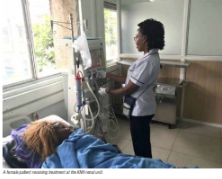
The country’s leading referral hospital KNH in January 2018 acquired two acute multi-therapeutic Continuous Renal Replacement Therapy (CRRT) Amplya machines that will other than treating kidney disease also be used in the treatment of sepsis, multiple organ failure, trauma and lupus.
This will see the treatment of kidney failure drop to less than Sh100,000 at KNH, with a session of general dialysis costing about Sh10,000. KNH plans to work with the National Hospital Insurance Fund (NHIF) to ensure the fund caters for innovations in renal treatment, making the treatment options more affordable to patients.
Attempts aimed at improving the service are ongoing with the up scaling of the renal department at KNH being underway. The complex once complete will see an increase of theatre time and space which will increase the current number by at least three times. The East Africa Kidney Institute (EAKI) is an East African Community initiative through a grant from AfDB to the Kenyan government. It is set to be a center of excellence in nephrology and urology once operational and is currently domiciled at KNH and the University of Nairobi. Seven Fellows are already in training at the institute.
The coming of the institute has seen tremendous growth in infrastructure development at KNH with state of the art equipment already benefiting patients. A new high edge tissue-typing machine is in its final stages of installment and will see a significant reduction in the cost of transplant work up. The current sourcing of a key laboratory test for matching donors to recipients from India and South Africa will be history at a very affordable cost locally.