





By Stephen Macharia
The Medical Credit Fund (MCF), a not for profit organization that lends money to health investments, has announced a COVID-19 specific fund targeting small and medium-sized enterprises (SMEs) in the manufacture, importation, and distribution of Covid-19 related commodities.
This means SMEs can now apply for credit at MCF to fund business operations in the supply of personal protective equipment (PPE) such as masks, eye protection, gloves, gowns, and hand sanitizers.
MCF has already disbursed loans worth Sh148m to manufacturers and suppliers of pharmaceutical supplies in Kenya and Uganda.
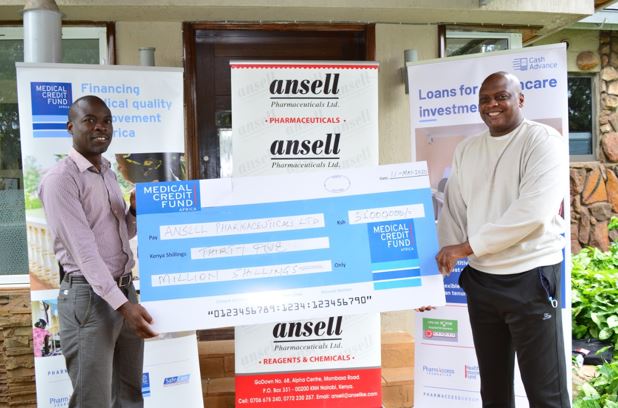
In Kenya, Ansell Pharmaceuticals Limited, a wholesaler and distributor of medical, pharmaceutical, and surgical products from Kiambu County, received over Sh35 million, becoming the first recipient of the MCF Covid-19 fund.
Speaking at a ceremony in Nairobi in May, Dr. David Karanja, a pharmacist, and founder of Ansell Pharmaceuticals said the funds will help his company provide quality and reasonably priced products.
“The loan from MCF is a timely intervention as it enables us to be in the frontline to supply the much needed medical equipment and related supplies to combat the pandemic,” he said.
MCF – part of the PharmAccess Group (a Dutch-based international NGO) – finances healthcare SMEs in Africa in a bid to improve access to quality healthcare services for low-income patients.
This is because many SMEs, including healthcare companies, have poor infrastructure, equipment, and limited means to invest in quality improvement. However, commercial banks shy away from these health SMEs because they consider them to be too risky.
MCF Kenya Director Kennedy Okong’o, Director says, “the COVID-19 pandemic has thrust the health enterprise into unprecedented times. Many health entrepreneurs have faced both health and economic impacts occasioned by low patient traffic and an interrupted supply chain. Our core business is to keep the health business running. That is why we have responded by developing Covid-19 specific loans and restructured existing loans to cushion our clients”.
Commercial lending portfolio to health SMEs accounts for a meager 2% of the loan portfolio in the country, limiting credit options for many investors in the sector.
This is because the health SMEs have poor infrastructure forcing financial institutions to shy away from the sector, MCF says.
A recent World Health Organization (WHO) modelling estimates a monthly global demand for PPEs to be 89 million medical masks, 76 million examination gloves, and 1.6 million goggles as the world counters the COVID-19 pandemic.
Globally, the demand for PPEs has surged. Last month, the WHO has called on manufacturers to increase output by 40 percent to meet the demand.
“Since the start of the COVID-19 outbreak, prices have surged. Surgical masks have seen a sixfold increase, N95 respirators have trebled and gowns have doubled. Supplies can take months to deliver and market manipulation is widespread, with stocks frequently sold to the highest bidder,” WHO said.
Recently, the WHO published guidelines on the rational use of PPEs and proposed several measures to reduce their use.
The WHO, for instance, called on healthcare workers to use “telemedicine to evaluate suspected cases of COVID-19 disease to minimizing hospital visits” and urged health facilities to restrict “healthcare workers from entering the rooms of COVID-19 patients if they are not involved in direct care” as a measure to reduce the use of PPEs.
“The current global stockpile of PPE is insufficient, particularly for medical masks and respirators; the supply of gowns and goggles is soon expected to be insufficient also. Surging global demand-driven not only by the number of COVID-19 cases but also by misinformation, panic buying, and stockpiling − will result in further shortages of PPE globally. The capacity to expand PPE production is limited, and the current demand for respirators and masks cannot be met, especially if the widespread, inappropriate use of PPE continues.