




• Contact Us
Saturday, January 17, 2026
Health Business
Advertisement
  • Home
  • News
    Oxford Licenses Rift Valley Fever Vaccine to Serum Institute Amid West Africa Surge

    Oxford Licenses Rift Valley Fever Vaccine to Serum Institute Amid West Africa Surge

    PS Muthoni Calls for Increased Cervical Cancer Screening during January Awareness Month

    PS Muthoni Calls for Increased Cervical Cancer Screening during January Awareness Month

    Hazardous Waste Landfill in Wajir Remains Active Despite Court Oder

    Hazardous Waste Landfill in Wajir Remains Active Despite Court Oder

    Kenya Accelerates Push Toward WHO Maturity Level 3 to Strengthen Pharmaceutical Regulation

    Kenya Accelerates Push Toward WHO Maturity Level 3 to Strengthen Pharmaceutical Regulation

  • Events
  • Private
    • KHF
    • Providers
  • Government
    • Medical Research
    • Politics & Policy
    • Regulation, Enforcement & Compliance
  • Finance
  • Tech
  • Epaper
  • Videos
  • Home
  • News
    Oxford Licenses Rift Valley Fever Vaccine to Serum Institute Amid West Africa Surge

    Oxford Licenses Rift Valley Fever Vaccine to Serum Institute Amid West Africa Surge

    PS Muthoni Calls for Increased Cervical Cancer Screening during January Awareness Month

    PS Muthoni Calls for Increased Cervical Cancer Screening during January Awareness Month

    Hazardous Waste Landfill in Wajir Remains Active Despite Court Oder

    Hazardous Waste Landfill in Wajir Remains Active Despite Court Oder

    Kenya Accelerates Push Toward WHO Maturity Level 3 to Strengthen Pharmaceutical Regulation

    Kenya Accelerates Push Toward WHO Maturity Level 3 to Strengthen Pharmaceutical Regulation

  • Events
  • Private
    • KHF
    • Providers
  • Government
    • Medical Research
    • Politics & Policy
    • Regulation, Enforcement & Compliance
  • Finance
  • Tech
  • Epaper
  • Videos
No Result
View All Result
Health Business
No Result
View All Result

Coronavirus reinfection – what it actually means, and why you shouldn’t panic

by Health Business
September 1, 2020
in News
0
Coronavirus reinfection – what it actually means, and why you shouldn’t panic
Share This:

Zania Stamataki, University of Birmingham

Scientists in Hong Kong have reported the first confirmed case of reinfection with the coronavirus that causes COVID-19, reportedly backed up by genetic sequences of the two episodes of the 33-year-old man’s infections in March and in August 2020. Naturally people are worried what this could mean for our chances of resolving the pandemic. Here’s why they shouldn’t worry.

Nearly nine months after the first infection with the novel coronavirus, we have very poor evidence for reinfection. However, virologists understand that reinfection with coronaviruses is common, and immunologists are working hard to determine how long the hallmarks of protective immunity will last in recovered patients.

The rare reports of reinfection so far were not accompanied by virus sequencing data so they could not be confirmed, but they are quite expected and there is no cause for alarm.

Inhospitable hosts

Our bodies do not become impervious to viruses when we recover from infection, instead, in many cases, they become inhospitable hosts. Consider that beyond recovery, our bodies often still offer the same cell types – such as cells of the respiratory tract – that viruses latch onto and gain entry for a cosy haven to uncoat and begin producing more viruses. These target cells are not altered in any substantial way to prevent future infections months after the virus has been cleared by the immune response.

If antibodies and memory cells (B and T cells) are left behind from a recent infection, however, the new expansion of the virus is rather short lived and the infection is subdued before the host suffers too much – or even notices at all.

This appears to be the case with the Hong Kong patient, who did not present any symptoms of the second infection, which was discovered following routine testing at the airport. Would he ever know that he had been reinfected had he not travelled? Probably not. A more interesting question is, was he contagious during his asymptomatic second infection?

There is mounting evidence that asymptomatic and presymptomatic people are contagious and this is why the sensible official advice is to wear face coverings to avoid infecting other people and to keep our distance to avoid getting infected. Coronaviruses from previous colds have endowed some of us with memory T cells that can also mobilise against the novel coronavirus, and this could explain why some people are spared severe disease.
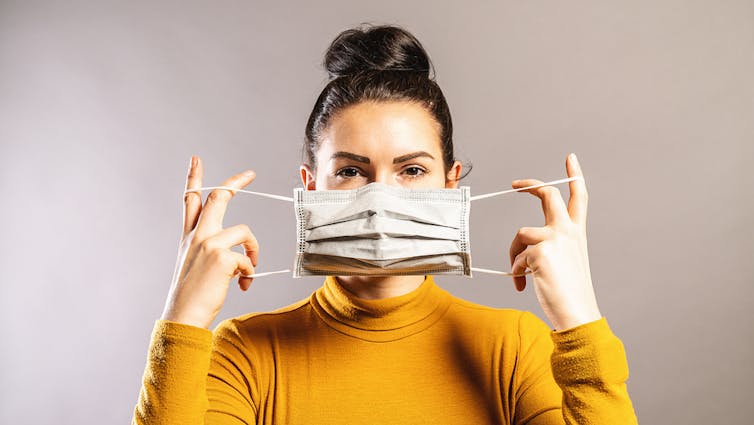
Woman putting a face mask on
Even if you’ve recovered from an infection, you should still follow official advice, such as wearing a mask.
r.classen/Shutterstock

Three potential outcomes

So how should we receive the news on reinfection of recovered individuals? There are three possible outcomes of reinfection with a similar virus: worse symptoms that lead to more severe disease, the same symptoms as the first infection, and improvement of symptoms leading to milder or no disease.

The first outcome is known as disease enhancement and is noted in patients infected with similar strains of viruses such as dengue. There is no evidence for this for the novel coronavirus, despite over 23 million confirmed cases of COVID-19 worldwide.

The second outcome, where the patient suffers the same disease twice, indicates that there is no sufficient immunological memory left behind to protect from reinfection. This could happen if the first infection did not require antibodies or T cells to be resolved, perhaps because other rapidly deployed immune defences were enough to control it.

The final outcome is milder infection thanks to a healthy immune system that generated antibodies and memory B and T cell responses that persisted long enough to be of value during the second exposure. Given the diversity of antibody and T cell responses reported in different COVID-19 patients, we anticipate that immune protection – if efficient – may vary in different people.

Of course, this has implications for the potency and duration of herd immunity, the idea that when we reach a large number of recovered patients immune to reinfection, this will protect the most vulnerable. Therefore vaccination is critical to induce and sustain protective immune responses in the long term.

Vaccination can elicit more potent and longer-lasting immune responses compared with natural infection, and these can be sustained by booster vaccinations when necessary. This is why scientists were not surprised to hear of evidence of reinfection. The lack of symptoms experienced by the Hong Kong patient is very good news.The Conversation

Zania Stamataki, Senior Lecturer in Viral Immunology, University of Birmingham

This article is republished from The Conversation under a Creative Commons license. Read the original article.


Share This:
Previous Post

Traditional Chinese medicine used to control viral pneumonia now available in Kenya

Next Post

Is body weight affected by when you eat? Here's what science knows so far

Related Posts

Oxford Licenses Rift Valley Fever Vaccine to Serum Institute Amid West Africa Surge
News

Oxford Licenses Rift Valley Fever Vaccine to Serum Institute Amid West Africa Surge

January 15, 2026
PS Muthoni Calls for Increased Cervical Cancer Screening during January Awareness Month
News

PS Muthoni Calls for Increased Cervical Cancer Screening during January Awareness Month

January 13, 2026
Hazardous Waste Landfill in Wajir Remains Active Despite Court Oder
News

Hazardous Waste Landfill in Wajir Remains Active Despite Court Oder

January 8, 2026
Next Post
Is body weight affected by when you eat? Here’s what science knows so far

Is body weight affected by when you eat? Here's what science knows so far

Leave a Reply Cancel reply

Your email address will not be published. Required fields are marked *

No Result
View All Result

Follow Us

Most Read

  • PS Muthoni Calls for Increased Cervical Cancer Screening during January Awareness Month

    PS Muthoni Calls for Increased Cervical Cancer Screening during January Awareness Month

    0 shares
    Share 0 Tweet 0
  • Oxford Licenses Rift Valley Fever Vaccine to Serum Institute Amid West Africa Surge

    0 shares
    Share 0 Tweet 0
  • Court Mandates Degree-Level Pharmacists to Run Kenya’s Top Hospitals

    0 shares
    Share 0 Tweet 0
Health Business

Health Business contains need-to-know features, news and case studies that explain the administrative and commercial issues affecting healthcare and hospital management. Health Business supports several high profile exhibitions - coverage of which is always timed for maximum impact. Regular topics include ICT, Finance/Funding, Facilities Management, Security, Health & Safety. Contributors range from government ministers through to top-level health administrators and association chairs.

Top Stories

Oxford Licenses Rift Valley Fever Vaccine to Serum Institute Amid West Africa Surge

Oxford Licenses Rift Valley Fever Vaccine to Serum Institute Amid West Africa Surge

January 15, 2026
PS Muthoni Calls for Increased Cervical Cancer Screening during January Awareness Month

PS Muthoni Calls for Increased Cervical Cancer Screening during January Awareness Month

January 13, 2026
Hazardous Waste Landfill in Wajir Remains Active Despite Court Oder

Hazardous Waste Landfill in Wajir Remains Active Despite Court Oder

January 8, 2026

Interests

  • Events
  • Finance
  • Government
  • Magazines
  • Medical Research
  • News
  • Politics & Policy
  • Providers
  • Public Health
  • Regulation, Enforcement & Compliance
  • Technology
  • Videos

Follow Us

  • Contact Us

© 2019 | Site by Mark & Ryse.

No Result
View All Result
  • Home
  • News
  • Events
  • Private
    • KHF
    • Providers
  • Government
    • Medical Research
    • Politics & Policy
    • Regulation, Enforcement & Compliance
  • Finance
  • Tech
  • Epaper
  • Videos

© 2019 | Site by Mark & Ryse.