



By Samuel Doe
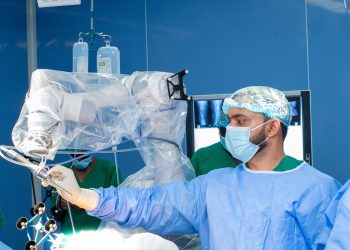
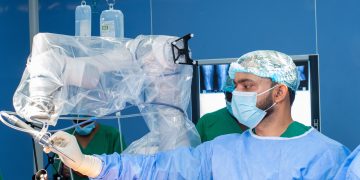
MP Shah Hospital has pioneered the use of the Sentimag guidance system in breast cancer surgery, providing the most modern and innovative solutions to Cancer treatment in East Africa.
According to Consultant Oncoplastic Breast Surgeon Dr Marek Ostrowski, the hospital has introduced the use of Sentimag guidance system and the innovative Magtrace lymphatic tracer, a liquid that provides a flexible and accurate way to detect sentinel lymph nodes that offers patients the highest standard of breast cancer staging without the need for radioactivity and blue dyes.
“The Breast Unit at MP Shah Hospital has become a regional centre for breast cancer care as it pioneers the use of the Sentimag guidance System for lymph node and cancer localisation during surgery,” he said adding that “The Sentimag guidance System allows medical professionals to mark small breast cancers or cancerous lumps before neoadjuvant chemotherapy.
The Magseed marker is a tiny seed designed to accurately mark the site of cancer and help with its removal in surgery.” Historically, all of the axillary lymph nodes were removed in an operation called axillary lymph node dissection (ALND) in women diagnosed with breast cancer.
This was done for two reasons: to help stage breast cancer and to help prevent a regional recurrence of the disease. If breast cancer spreads, it typically goes first to nearby lymph nodes under the arm; therefore, assessment of the lymph nodes is essential in the treatment of breast cancer. To help find out if cancer has spread outside the breast, one or more of the lymph nodes under the arm axillary lymph nodes are removed and checked in the lab.
“Anyone with invasive breast cancer will have the lymph nodes under the arm assessed, this procedure outcome helps the treatment team to recommend which treatments are best and Sentinel lymph node biopsy (SLNB) is the most common and least invasive way,” he said.
Lymph node surgery is often done as part of the main surgery to remove the breast cancer, but in some cases, it might be done as a separate operation. In a sentinel lymph node biopsy (SLNB), the surgeon finds and removes the first lymph node(s) to which a tumour is likely to spread called the sentinel nodes. To do this, usually, the surgeon injects a radioactive and a blue dye into the area around the tumour. Lymphatic vessels will carry these substances along the same path that cancer would take.
The sentinel node will be the first lymph node(s) the substances travel. Sentinel node biopsy reduces the possible longterm effect of lymph node surgery such as swelling in the arm or chest called lymphedema.
Detected by the Sentimag localisation system and indicated for long-term implantation in any soft tissue, it enables more flexible and precise tumour localisation during surgery. He says that the procedure is very simple and can often be completed in a matter of minutes. The Magseed marker can be placed days, weeks or months ahead of surgery.