





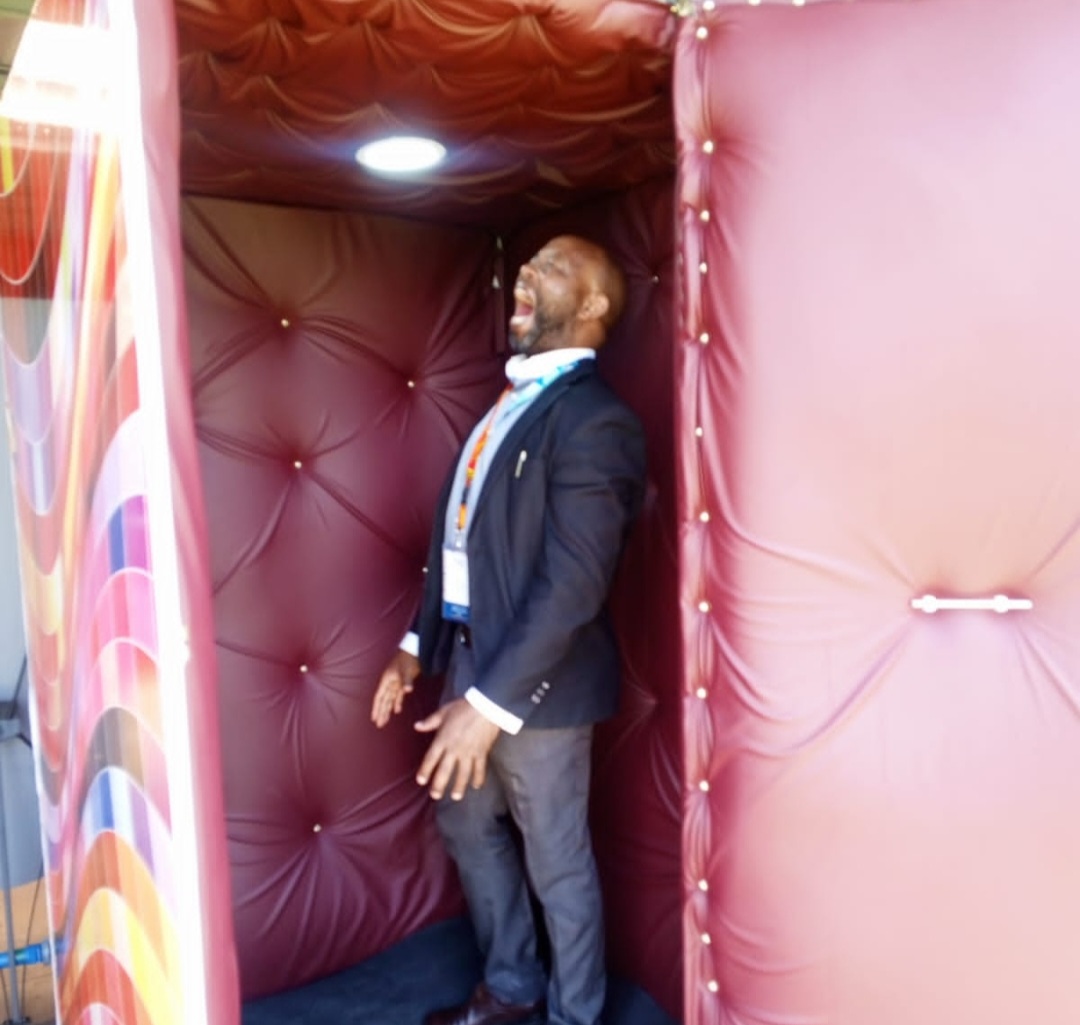
John landed early Wednesday, on time for the start of a medical technology conference in Nairobi.
He had a presentation – on a promising solar-assisted innovation for tackling rural Non-Communicable Diseases (NCDs) in a solar-powered mobile clinic with integrated diagnostic tools and tele-health capabilities – to make but due to flight issues from his country of origin, he was not adequately prepared.
John, a medical doctor and innovator, needed time to unpack unnecessary burden in his mind, in order to focus on the presentation, which was already highly rated. In one of the booths exhibiting various innovative medical tools, there was a small stand-alone coloured structured with acoustic material covered by a dark canvas which cold only allows one occupant per session.
“Hello sir, you look unsettled,” Joseph Boni, a mental health advocate from Mindful Kenya approached John.
“You look unsettled,” he beamed once again, and John admitted. “Yes, I need a place to organize my presentation, but first of all to breathe out.”
Boni directed John to the Screaming Box, the unique stand-alone booth. He briefly spoke to him before he stepped inside, and closed the door behind him. In about 10-20 seconds, the tall gentleman stepped out, looking somehow relaxed, and sat with Boni at the far end of the Shamba Café compound in Loresho.
An analysis using the 2022 Kenya Demographic Health Survey (KDHS) data identified a prevalence of 3.84 percent for depression, or anxiety among adults aged 15-49 and associated risk factors like sexual violence and chronic illness.
Did you know that screaming for a few seconds, up to the count of 10, can help reduce stress levels?
If you ask Artificial Intelligence whether screaming is healthy, it will answer this way.
“Screaming is not inherently healthy, as it triggers a stress response involving hormones like cortisol and adrenaline, which can have long-term negative effects, especially when prolonged.
“However, brief, controlled screaming can be a therapeutic release, reducing tension and potentially leading to a sense of calm after the initial stress response subsides. It’s best as a temporary stress release, rather than a primary emotional regulation strategy, and should be balanced with calming practices and potentially professional help if used to manage overwhelming emotions.”
This is exactly what John felt as he rejoined the meeting, Transforming African Medtech Conference (TAMC) 2025. This year’s theme: _Driving MedTech Transformation through Creativity,_ Collaboration, and Action, aims at shaping the future of Medical Technology on the continent.
John’s presentation revolves around a solar-powered mobile clinic which directly addresses challenges like unreliable power, lack of diagnostic access, and limited healthcare provider networks in remote areas. This mobile unit can bring essential services for screening, diagnosis, and monitoring directly to communities, utilizing solar power for equipment like blood pressure monitors and glucose meters, and using satellite internet for remote consultations with specialists.
Back to the Screaming Box and the idea behind it, is entirely on stress level management in just 10 seconds where a person who feels their mind is piling with unresolved issues, steps in and screams at the top of their voice. And when they come out, they are able to focus on the most important issues.
“We have made a very interesting space. It’s called a screaming room, where people can breathe their stress, yeah; it’s a very smart space. In this room, people can release their minds, get time to talk to themselves,” Boni explained.
The Screaming Box is an innovative idea for stress management founded by Thalia Psychotherapy, an organization that’s specialized in mental wellness.
In this room, he says when a person is screaming; they are talking to themselves, and conversing within, eventually by experiencing a release of the mental burden.
Boni explained further that before starting to engage any person, most of the times they are a person who needs their own space.
“Most of the times when someone has this depression, he or she needs their own space. So before you talk to these persons, you start guiding them what to do, where to start, and how to heal, and you have to give them time to think about what they’re going to say, and how it’s going to help,” he said during an interview.
And so, he continues, first, these persons need their space, release their minds by screaming, and in the next minute they are able to talk.
Asked what is special about the screaming, Boni said; “Screaming releases stress. So the way we chose the screaming room or the importance of the screaming room, it helps in emotional releases, and always reduces stress,” he said.
And by giving themselves a space to feel and express intense emotions, they become better, since the place is safe, Boni added.
He said when a person gives themselves a space of 12 to 20 seconds, they become very different.
“Because 20 are long, when you count 1, 2, 3 to 20, that person can tell you a lot,” he said.
However, they allow people who require the screaming therapy up to 20, 30 minutes in order to be able to overcome their stress, almost completely.
So far, through this program, the organization has been able to reach out to about 174 clients in several places in Nairobi and adjacent areas since July this year.
The African Medtech conference is organized by Villgro Africa and supported by the Africa Union Development Agency (AUDA-NEPAD), Lemelson Foundation, Kenya University, East Africa Biodesign, PATH, and the International Development Research Centre (IDRC) among others.
The other institutions include, Hatch Technologies, Ifakara Innovation Hub, Open University (UK),
RICE360- Institute for Global Health Technologies at Rice University, Africa Medfical Research Foundation (AMREF), Jaza Rift, and Aspen Network of Development Entrepreneurs (ANDE).