
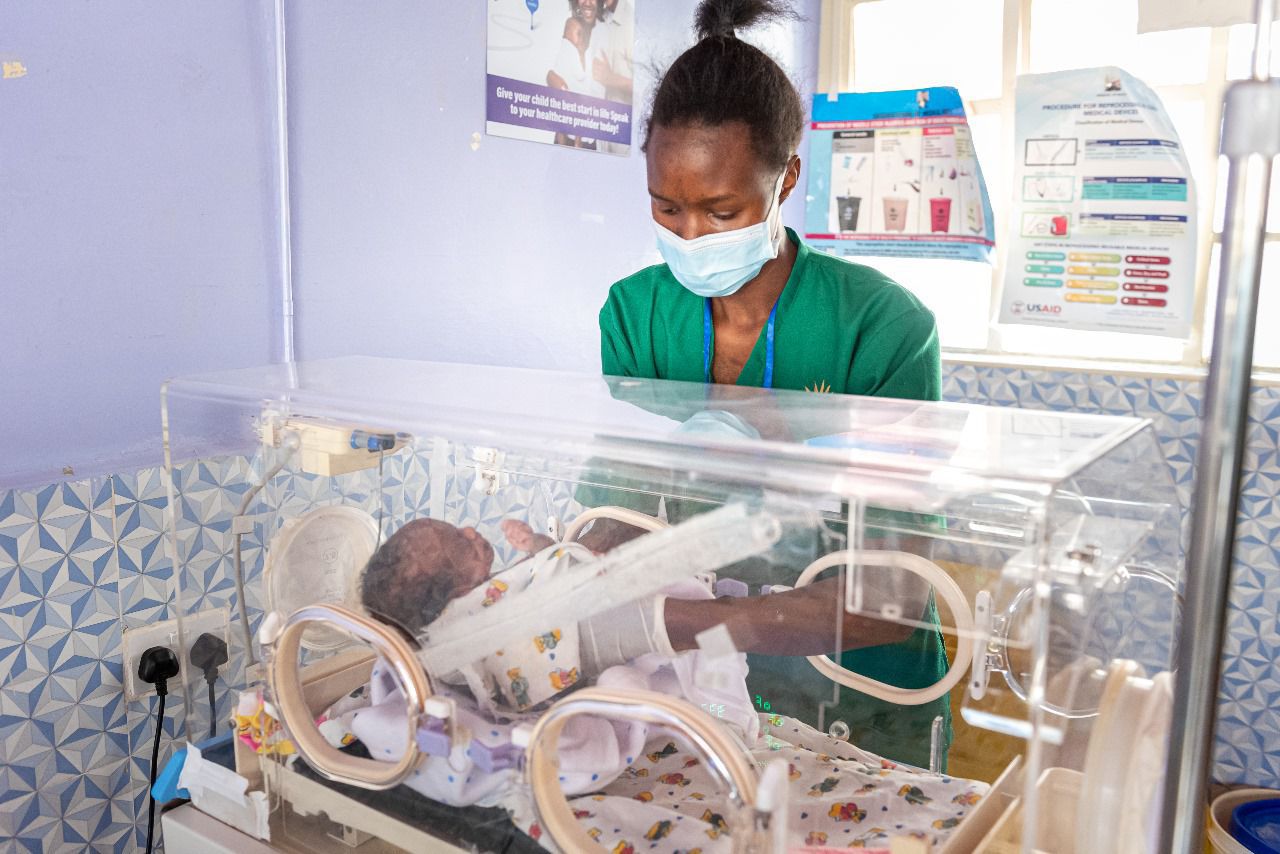
Inside Pumwani Maternity Hospital Newborn Unit (NBU), the air is filled with insistent cries of the tiniest humans fighting for life, beyond the rows of incubators is a quiet room lined with private pumping stations, and just past that is a sealed door, step inside, and the temperatures fall dramatically.
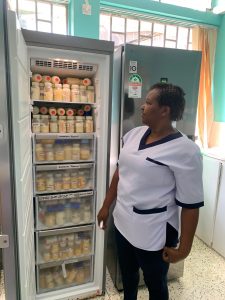
The room houses several refrigerators set at -18 degrees Celsius, a pasteurization machine, and bottle-sterilizing equipment. This is the heart of Kenya’s first-ever Human Milk Bank.
Inside the freezers are neatly arranged bottles of breast milk, each labelled and filled with what neonatologists refer to as ‘liquid gold’ due to its unmatched nutritional and immunological value that saves the lives of babies whose bodies are too fragile to survive without it.
For a premature baby, the struggle to stay alive begins the moment they are born. From that first breath, almost everything works against them, from asphyxia, hypothermia or even hospital-acquired infections. This reality is reflected in data as Kenya loses 92 newborns a day according to the Ministry of Health.

For these fragile infants, milk is not just food. It is medicine and when that milk comes from their mother it gives them a better chance of survival. When a baby is born that first suckle on breast milk is their first immunization, the milk is rich in colostrum that provides antibodies that gives them a head start in life.
Yet, many newborns miss out, babies born under traumatic circumstances where mothers experience severe complications, delayed milk production, or serious illness often cannot be breastfed in those critical early days. This is where donor human milk comes in.
At Pumwani Maternity Hospital- East Africa’s largest maternity hospital that delivers nearly 15,000 babies annually, the Human Milk Bank has become a quiet but powerful intervention. For many babies in the NBU, donated breast milk is what stabilizes them before complications such as pneumonia, malnutrition, or feeding intolerance take hold.
For Linda*(not her real name) her latest Journey to motherhood was nothing short of traumatic, the mother of two suffered complications while delivering her daughter, she was rushed to Kenyatta National Hospital (KNH) for specialized care leaving her preterm daughter in the NBU at Pumwani.
Linda’s baby was among those who relied on donated human milk in her earliest days of life.
“Many of our mothers want to breastfeed, but sometimes circumstances make it impossible,” says Hannah Maina, a neonatal nurse at Pumwani and the officer in charge of the Human Milk Bank. “That is when donor milk becomes critical.”
Which was the case for Mary Wangeci whose milk did not come in for days, leaving her premature daughter vulnerable.
“When my baby was born I could not produce milk, she was in the NBU for weeks,” she explains “she could not have formula, instead the doctor spoke to me about the donor milk and I gave consent for her to receive it.”
After a few days on the donor milk her own milk finally came in allowing her baby to transition to breastfeeding.
In Kenya, Prematurity is the leading cause of neonatal mortality. According to data from the Kenya Demographic and Health Survey (KDHS) 2022, the rate of neonatal mortality stands at 21 per 1000 live births, premature babies make up the majority of admissions in Pumwani’s Newborn Unit.
“We see a large number of preterm babies In the NBU here,” Maina says “they are categorized in three: we have below 1,000g these are called extreme preterm babies, some are 1,000g to 1,900g. Those are moderate preterm babies and they are the majority.”
Wangeci and her daughter left the hospital at a healthy weight of 2.6kgs.
Most preterm suffer an array of complications due to underdeveloped organs, in the short term they often struggle with breathing, maintaining body heat and are prone to infections.
Their lack of a sucking reflex makes feeding particularly difficult and most rely on nasogastric (NG) tubes or cups. But even more concerning is their undeveloped gut that makes it hard for them to tolerate most forms of baby formula which can cause necrotizing enterocolitis (NEC).
NEC is a serious intestinal complication that can turn fatal as it causes inflammation and eventual tissue death of the bowel leading to holes forming.
“If you give formula milk to a preterm baby, they are at high risk of developing necrotizing enterocolitis,” Maina says. “Because of this risk, donated breast milk is often the safest alternative when a mother’s own milk is unavailable.”
Why Breast milk over Formula
Dr. Njoki Githura, Deputy Medical Superintendent at the Pumwani Maternity Hospital, lauded the Human Milk Bank as one of the hospital’s most impactful innovations.
“Breast milk is superior because of the nutritional value it provides.it is very difficult to replicate breast milk.” She noted.
Adding, “If a baby cannot access breast milk, their start in life is already compromised. Nutrition determines how strong that baby will be. From the very beginning, milk is very important.”
Beyond improving neonatal survival, breast milk also offers economic relief for mothers, most who have to stay in the NBU for months.
“Formula is not a luxury, it is sometimes a necessity but it is expensive. Donor milk provides a cost-effective solution, especially for preterm babies who consume large volumes over long hospital stays, and here we provide it for free.”
Safety is another advantage.
“We process the milk entirely within the hospital,” she explains. “From donation to pasteurization and storage, we can account for every step. That assurance is critical when feeding such vulnerable children.”
Inside the Milk Bank
Established in 2018, Pumwani’s Human Milk Bank receives milk donated by lactating mothers mostly within the hospital who have excess supply. Donors undergo a rigorous screening process, laboratory tests for HIV, Hepatitis, Measles and other transmittable illnesses.
“We test them again and don’t rely on their clinic books,” Maina explains. “Our checklists involve checking for risk behaviors like smoking, tattoos in the last 12 months and so on, if they pass we then proceed to counseling then proceed to donate.”
Donors can express between 50ml to 250ml.”
Apart from the testing the screening process also includes an extensive checklist that determines the donor mothers’ ability to donate including medical history on chronic illness like Cancer, once this process is done mothers can donate. The milk is then carefully labeled, Pasteurized and tested again before it is stored in specialized refrigerators set at -18 degrees Celsius.
After all this the milk is then prescribed to babies by the doctor.
The milk is also labeled with donors’ names and categorized into preterm and term milk.
“Milk from mothers who deliver preterm babies is richer in fats and nutrients,” Maina explains. “We give that milk specifically to other preterm babies whose mothers cannot breast feed so they can gain weight faster and build immunity.”
According to Maina, in a good week, the milk bank can produce up to 1,500 feeds. Pumwani also supplies donor milk to other facilities, including Mama Lucy Kibaki Hospital and Mbagathi Hospital free of charge.
She says that Kenyan mothers are more than willing to donate.
“This year (2025) is the first time we have received so much milk from our mothers that we had to get an extra refrigerator.”
‘Liquid Gold’
Agnes Karungu, a donor mother, says she first learned about milk donation through the radio and later learned more during routine health talks at Pumwani.
“I had a lot of milk and when the baby is young they don’t need as much so I had excess” she says. “So I decided to help the babies who really needed it.”
She encourages other mothers to donate excess milk rather than let it go to waste.
For Dr. Githura, the impact of donor milk goes beyond statistics.
“I call it liquid gold quite literally,” she says. “From the mother who donates to the baby who receives it, it costs almost nothing. Yet it saves lives.”
Despite its success, the milk bank faces challenges. As the project was initially donor-funded, the maintenance and expansion are often uncertain. Equipment breakdowns and staffing limitations can threaten operations.
Staff specially trained needed to run it can also be reassigned at any time.
At the moment the Milk bank at Pumwani is the only existing one, it serves not only Pumwani but other level five hospitals like Mama Lucy and Mbagathi Hospital, however, Dr. Githura warns that this is not sustainable.
“We cannot supply everyone,” Dr. Githura admits “That is the painful part.”
Calling for a concerted effort, she noted that newborn survival does not need new inventions but investments and upscaling of existing interventions.
“Because the neonates don’t speak up their needs are assumed, we don’t need to reinvent the wheel when something as simple as this milk bank can make a big difference, this needs to be upscale to other hospitals, we have seen its impact and it needs to be the norm like blood donation.”