


For more than two decades, Kenya’s health system has depended heavily on external donor financing to sustain critical services, particularly for HIV, tuberculosis and malaria.
According to health activists donor support has funded laboratories, surveillance systems, medicines and a significant portion of the health workforce.
They said that while this assistance has saved millions of lives, Kenya’s continued reliance on foreign aid has left the health system dangerously exposed.
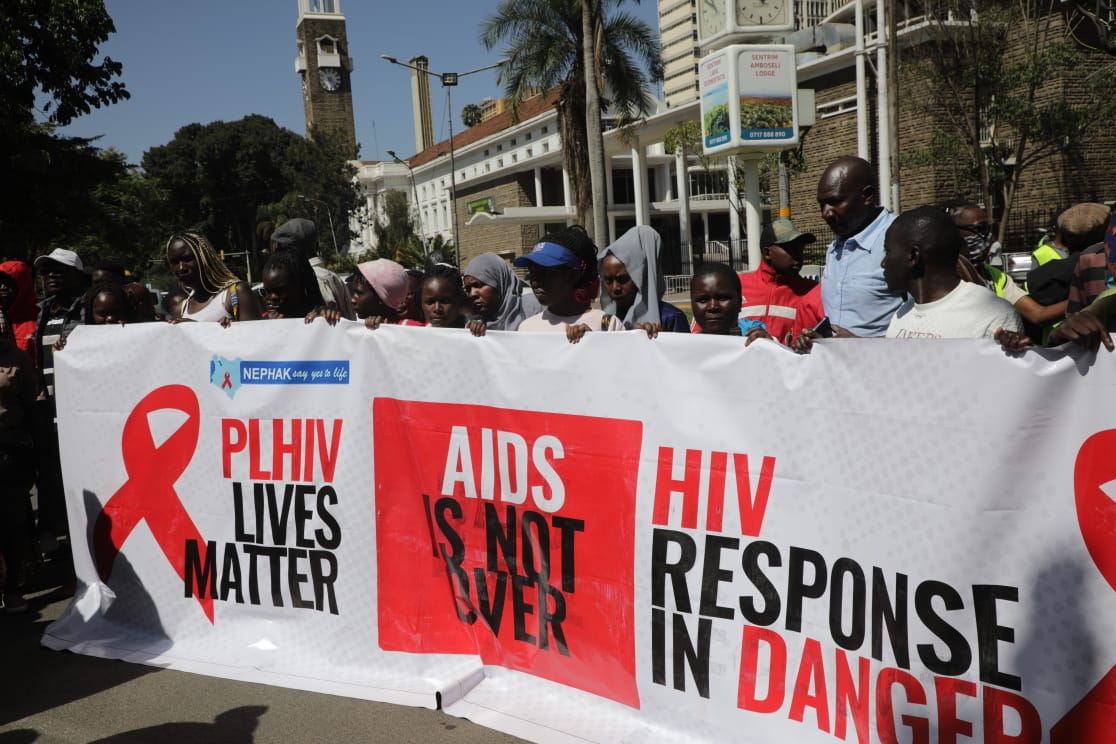
On Friday, the National Empowerment Network of People Living with HIV and AIDS (NEPHAK) took the fight for survival to the gates of Parliament, demanding that lawmakers trade foreign dependency for domestic sovereignty.
The activists marched to Parliament and the High Court, warning political leaders that AIDS remains a national crisis and that continued silence and inaction could cost lives.
NEPHAK accused Parliament of failing to prioritize domestic financing for health at a time when global aid is declining amid geopolitical shifts, competing crises and changing donor priorities.
“The reason we are here today is to voice our concern that in Kenya, AIDS is not yet over,” said Nelson Otwoma, director of NEPHAK. “Parliament is responsible for making decisions on health financing, including HIV, and for a very long time it has not done that.”
Kenya’s HIV response has relied largely on external donors, particularly the United States government. That dependence was starkly exposed in February 2025, when a U.S. funding freeze issued as a stop-work order disrupted services across the country.
“Testing became a problem. Laboratory services like CD4 counts and viral load monitoring were affected,” Otwoma said. “Even access to second-line and third-line antiretroviral medicines was put in jeopardy.”
The impact was immediate. Health workers were laid off, specialized HIV services were scaled back, and the Ministry of Health was forced to integrate HIV care into general health services due to staff shortages.
In November, the U.S. government re-engaged Kenya, proposing to restore support through a government-to-government funding model but with a condition: Kenya would have to significantly increase its own investment in health.
The negotiations resulted in a five-year, $1.6 billion agreement covering five priority areas: HIV, tuberculosis, malaria, maternal health and polio. Under the agreement, Kenya is expected to fully take over epidemic control by 2030, finance services, employ health workers and provide comprehensive support to people living with HIV.
“That is what we have been calling for,” Otwoma said. “We want Kenya to be in the driving seat of the epidemic.”
But activists say the political response has been deeply troubling. During the funding freeze, they noted, no senior politician publicly raised alarm. After the new agreement was signed, however, a senator filed a court case challenging it.
“Instead of debating health issues in Parliament, leaders are running to court to block dialogue,” Otwoma said. “Parliament has the authority to summon the cabinet secretary or even the president to explain the agreement. Blocking available support puts the lives of 1.4 million Kenyans living with HIV at risk, as well as people with TB and malaria.”
NEPHAK said it will return to Parliament when lawmakers resume sittings and plans to replicate demonstrations across all 47 counties to press for sustained domestic health financing and accountability.
Among those marching was Joyce Adhiambo, who has lived with HIV for more than 28 years. Her survival, she said, reflects what consistent access to care can achieve — and what is at stake if funding falters.
“I have achieved a durable, undetectable viral load,” Adhiambo said. “I am also a TB patient and a survivor of cervical cancer, COVID-19 and gender-based violence.”
For her, debates over budgets and court cases are not abstract policy disputes. “These decisions determine whether people like me live or die,” she said. “That is why we came out in a peaceful demonstration.”
The protests also drew attention to funding and support to roll out emerging HIV prevention and treatment options, including lenacapavir, a long-acting injectable drug administered once every six months.
“With the US support we are sure that we will roll out Lenacapavir that will help young people who struggle with daily pills and discordant couples who want to have children safely,” said Bernard Baridi, Kenya’s National HIV Prevention Ambassador.
He cautioned, however, that the drug does not prevent pregnancy or other sexually transmitted infections.
As Kenya moves toward 2030, activists say the country faces a defining choice: build a sustainable, domestically funded health system or remain vulnerable to the uncertainties of global aid.
“Our appeal is simple,” Otwoma said. “If there are issues, bring them to Parliament. Debate them openly. But do not block life-saving support. AIDS is not over — and neither is our fight.”