





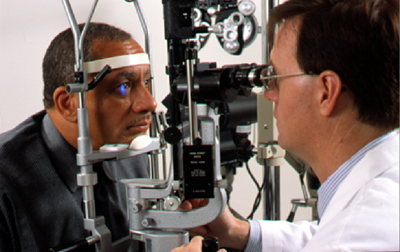
A simple eye test carried out by opticians could help predict who is at risk of developing dementia, a study suggests.
The test is usually done to spot early signs of eye disease, by looking at tissue at the back of the eye – the retina.
Now scientists have found people with thinner retinas are more likely to have problems with memory and reasoning.
Researchers believe the test could be used to screen for early dementia.
The study of 32,000 people measured parts of the retina, and in particular the retinal nerve fibre layer (RNFL), using optical coherence tomography (OCT).
Study participants, who were between the ages of 40 and 69, were also assessed on their memory, reaction time and reasoning.
Scientists found those with the thinnest RNFLs were more likely to fail one or more of the tests.
They were also twice as likely to score worse in follow-up assessments over the next three years, the study published in JAMA Neurology found.
Memory loss, difficulty with carrying out familiar tasks and other types of cognitive decline can be early symptoms of dementia.
Prof Paul Foster, from the University College London Institute of Ophthalmology, co-lead author of the paper, said OCT tests could help identify people at high risk of developing the disease.
Prof Foster added: “It is likely that treatments will be more effective in slowing or stopping dementia at earlier stages of the disease.
“Also, by targeting people in the earlier stages, it should be possible to design better clinical trials for treatments that make a real difference and improve people’s lives.” -BBC