





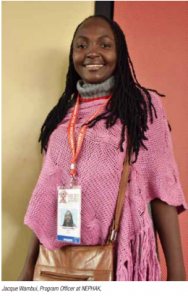
Health Business spoke with Jacque Wambui, Program Officer at NEPHAK, about the introduction and subsequent ban of Dolutegravir (DTG) in the Kenyan market. Her work involves engaging with young people born and living with HIV, building their capacity and following up with treatment and adherence including forming a support group. NEPHAK is a membership organisation of civil society organizations (CSOs) and community based organizations (CBOs) working in HIV programming.
NEPHAK’s mission is to promote greater and meaningful involvement of people living with HIV in the national response to TB and HIV/AIDS. NEPHAK is also one of the 17 organizations that make up the SRHR Alliance. Under the Get Up Speak Out (GUSO) Program implemented by the SRHR Alliance. NEPHAK increases utilisation of sexual reproductive health information and services including raising awareness of youth’s sexual reproductive health rights.
There is a relatively new drug (ARV) in the market, tell us something about it
Dolutegravir, commonly known as DTG, is an antiretroviral drug that has been available in high income countries for about 3-4 years. The generic version was however introduced to the Kenyan market in 2017 as a result of advocacy efforts by NEPHAK and other advocacy groups in Africa. Making Kenya the first African country to provide a generic version of DTG for routine use. The drug is efficacious.
It has a very low dosage in terms of milligrams –only 50 mg; it lasts longer in the body and has low toxicity making it a drug that is tolerable without much side effects.The generic version of DTG is also beneficial because it is cheaper to manufacture. It would therefore cost countries less to purchase, meaning the drug would be more accessible to PLHIV.
What does access to a generic drug such as Dolutegravir( DTG) mean for people living with HIV (PLWH)?
In addition to the previously mentioned benefits, everybody is quite excited about DTG because it lowers your viral load within the first six months.
What does the recent ban on prescription of DTG mean for PLWH?
The ban may affect levels of ARV resistance. PLWH feel that prior to issuing the ban of DTG for women of reproductive age, the Ministry of Health should have consulted women living with HIV, on what drug options we prefer to be given rather than issue a blanket ban of DTG as a first line treatment. The government ban is based off a World Health Organisation (WHO) statement on a potential safety issue with DTG that cites potential risk of neural tube defects in infants born to mothers taking DTG at the time of conception. WHO issued the statement following preliminary findings of an observational study in Botswana where 4 cases out of 426 women were found to have babies with neural tube defects.
What are some of the challenges efavirenz users face(d)?
Similar to DTG, efavirenz is a first line drug. The most common side effects are drowsiness and vivid nightmares. In fact, for most people it is recommended that efavirenz be taken at night because if taken during the day, you’ll hardly be active. Efavirenz also has an effect on organs.It was therefore necessary to do monitoring every 6 months. Some people complained about enlarged organs.
One good thing about efavirenz though, is that it raises your immunity very fast, which is very beneficial to those infected with tuberculosis.
What would you say are some of the barriers to adherence especially among young people?
Because of the drowsiness and other associated side effects of ARVS such as efavirenz, some youths say they can’t study. Many young people in school therefore opt not to take their medication because they are forced to choose between studying and taking the drug. Judgment is often passed on young people not taking their medications yet it is difficult to adhere to a drug that is not sitting well with your body.
And what can the government and other organizations do to reduce or stop these drug holidays?
Provide PLWH options to as well as provide a better drug for people to use. Advertiser’s Content Through the Get Up Speak Out program of the SRHR Alliance, NEPHAK is advocating for the rights of young people to receive comprehensive and accurate information including the right to youth friendly sexual reproductive health services. The concept of comprehensive sexual reproductive health information and services is important to us as partners of the SRHR Alliance because a young person will go and experiment if you don’t provide them with information. So give the young person the option to decide if they want to be on contraceptives or not.
As a youth sexual and reproductive health and rights (SRHR) advocate what are some of the concerns you have for youth and adolescents living with HIV?
We as part of the SRHR Alliance are mostly concerned with issues ofyouth access. Young people are not able to access many services because they are not friendly. Overworking of health workers is also a concern because health workers are not able to give young people the attention and care they deserve when they visit health facilities. Conservative values and attitudes of health workers also often pose a barrier to young girls trying to access contraception because they are shunned for engaging in premarital sex.
What are some of the recommendations the SRHR Alliance is calling for?
We are pushing for integration of reproductive health and HIV services so as to provide youth with a one stop shop for services pertaining to their wellbeing. Not only should there be the integration of reproductive health and HIV services, but they should be quality and youth friendly services.