





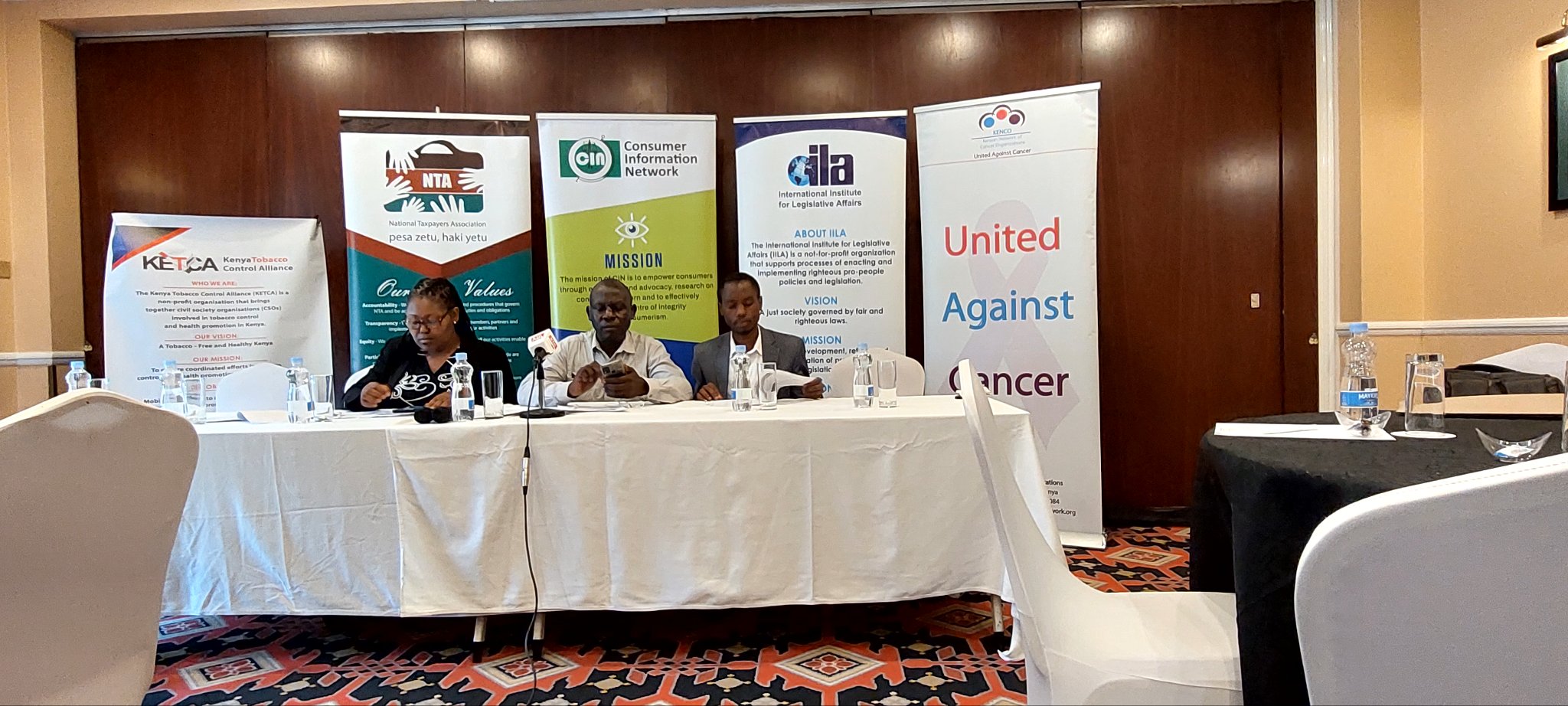
Anti-tobacco Civil society organizations (CSO’s) have challenged Kenya Kwanza government to take a bold stance against tobacco farming and the use of tobacco and novel tobacco products (New-generation products) saying that health and well-being of Kenyans must take precedence over short-term economic gains and outdated practices.
The anti-tobacco CSO’s made a press statement in the backdrop of previous utterances made by Moses Kuria, Kenya’s Trade Cabinet Secretary (CS) on economic benefits of tobacco industry, which the anti-tobacco crusaders regard as an attempt to explode and reverse prevention gains the country has made over time.
They claimed that Kuria’s statement came out as an endorsement and attempt to help raise the profile of the tobacco company, by enhancing its false ‘economic’ reputation therefore supporting the ‘normalization’ of the harmful industry.
The six anti-tobacco civil society organizations (CSO’s) namely Kenya Tobacco Control Alliance (KETCA), Consumer Information Network, International Institute for Legislative Affairs (ILA), National Taxpayers Association, Kenyan Network of Cancer Organizations (KENCO), NCDs Alliance-Kenya and SCAD, strongly disapproved utterances by the Trade CS terming it ‘misleading’.
The trade CS claimed that “The tobacco industry contributes more than 1percent of Kenya’s GDP, contributing more than 18 billion annually, employing thousands of our people and huge earnings to our tobacco farmers mostly in the counties of Busia, Migori and Homabay.”
The CS made the deceiving statements when he met with the Managing Director for British American Tobacco, Crispin Ocholla, and his team. “They met to discuss the Kenya Tobacco Control Act and Regulations that govern the industry,” The CSO’s told press in Nairobi.
The anti-tobacco CSO’s explained that tobacco farming may seem profitable in the short term but its long-term economic implications are dire.
They further clarified that health care costs associated with treating tobacco-related diseases among not only users but also farmers, far outweigh the economic benefits of the industry.
“Tobacco farmers are exposed to health challenges as a result of handling tobacco leaves, and their health is further compromised by food insecurity and poor nutrition since they do not produce sufficient food crops.”
They further elaborated that incidence of Cancer, in particular, is a growing concern in Kenya. Tobacco use significantly increases the risk of several types of cancer, including lung, oral, and esophageal cancer. “By controlling tobacco use, the government can actively reduce the burden of cancer, allowing for early detection, treatment, and improved survival rates.”
The CSO’s claimed that CS Kuria’s meeting with the leading tobacco industry player in Nairobi did not meet the laid down guidelines regarding interactions between public officers and the tobacco industry and was a direct contravention of Part V of the Kenya Tobacco Control Regulations (2014) and Article 5.3 of the WHO’s Framework Convention on Tobacco Control, which Kenya has signed and ratified.
The tobacco industry has a long history of unethical practices, including targeting vulnerable populations, using misleading advertising, and undermining public health policies. “The Trade CS openly showed support to tobacco farming, making Kenya inadvertently becoming complicit in these actions, which are inconsistent with the nation’s commitment to social justice and human well-being.”
Tobacco use remains a leading cause of preventable death and disability in Kenya as it kills over 9,000 Kenyans every year, according to the Ministry of Health. By contrast, the aim of the tobacco industry is to increase the amount of tobacco that people use, by dissuading cessation of existing smokers and encouraging new smokers (including young people) luring them to novel products which they claim are safer alternatives.
Kenya is a Party to the World Health Organization (WHO) Framework Convention on Tobacco Control (FCTC), which aims to protect present and future generations from the devastating health, social, environmental and economic consequences of tobacco consumption and exposure to tobacco smoke.
Article 5.3 of the WHO FCTC requires public officials to protect public health policies in relation to tobacco control “from commercial and other vested interests of the tobacco industry”.
Kenya’s obligations under Article 5.3 extend to new and emerging products, such as e-cigarettes and heated tobacco products, due to the increasing integration between their manufacturers and the tobacco industry.
The FCTC prohibits governments from engaging in any form of collaboration with the tobacco industry. This includes meetings, consultations, and other forms of communication. “The Kenya TCA is an important piece of legislation that is designed to protect public health in Kenya,” the CSO’s Said.
The prohibition of meetings between government officials and tobacco industry officials is an essential part of this legislation, they said adding that, it helps to ensure that government decisions are made in the best interests of the Kenyan people, rather than the tobacco industry. “The Kenyan Tobacco Control Act also clearly indicates the government must make an effort to end tobacco farming and use in Kenya.”