




One institution has the required data and laboratory re-agents, while the other one has modern equipment, cutting edge research technologies and accomplished expertise.
This is an evolving story of a healthcare Non-governmental Organisation (NGO), and a premier research institution.
It’s about a professional partnership between AIDS Healthcare Foundation (AHF) and the Kenya Medical Research Institute (KEMRI), which is emerging. And soon the institutions will sign a Memorandum of Understanding (MOU) to take research interventions on Sexually Transmitted Infections (STIs) forward.
This stems from evidence in data collected by the AHF showing that 2-5 percent of the clients undergoing syndromic treatment for STIs fail recovery.
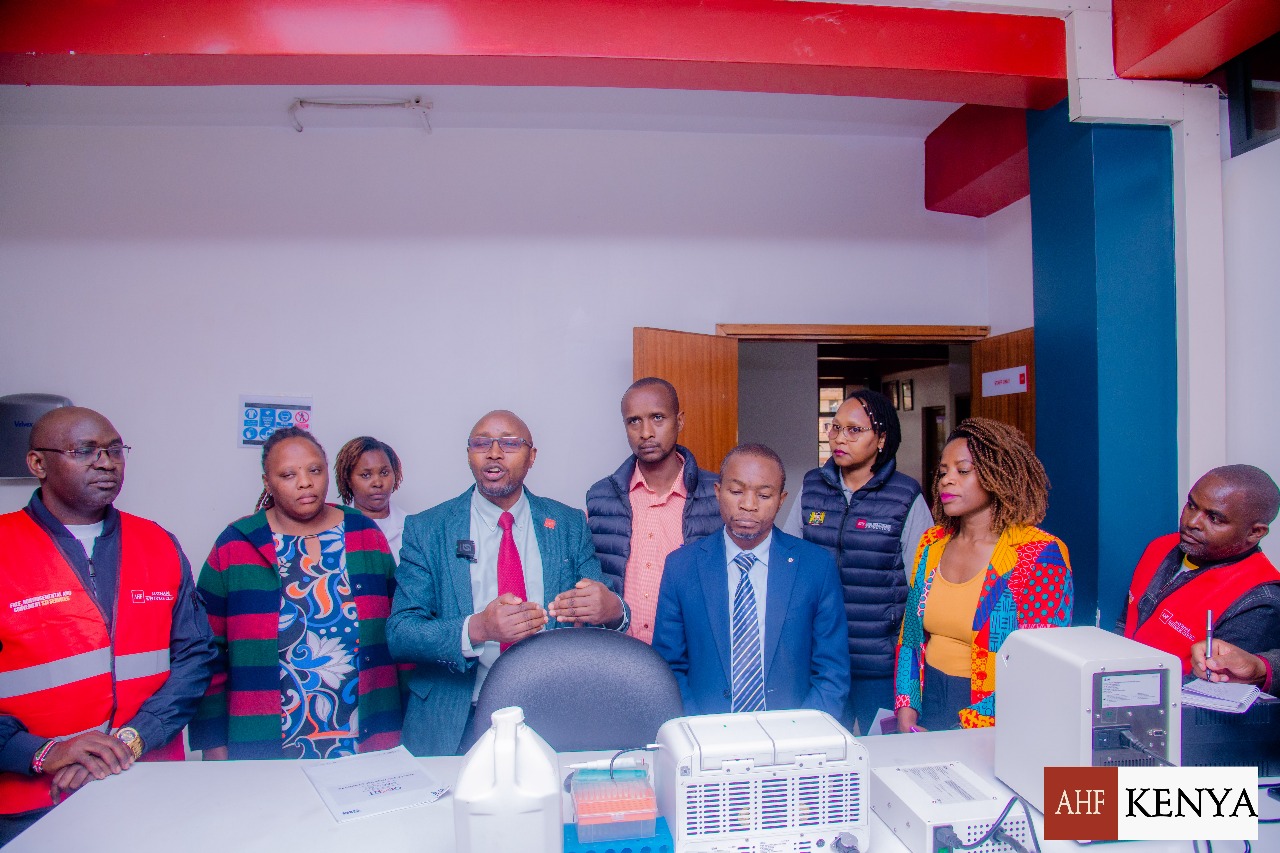
“For the STI program, we are noting about 2 to 5 percent of our clients may go through the three levels; first line, second line, third line treatment for syndromic treatment without recovery,” Dr. Samuel Kinyanjui, AHF Kenya Country Director said at the organisation’s Mathare clinic during the unveiling of an integrated wellness centre with modern STIs testing machines, capable of running 12 tests.
This, he noted, points to a situation where an STI strain is resistant to drugs, and a reason further investigation is conducted to ascertain the exact intervention that’s required to address the problem.
And for this reason, Dr. Kinyanjui revealed that’s why AHF has sought the services of KEMRI to enables its clients get the best services of drug sensitivity testing to be able to know exactly what drugs to use to cure its patients.
“And as a result, we believe and we have evidence that they are having an STI that is drug resistant to the common drugs,” he said, pointing out that through the collaboration with KEMRI will facilitate referral of resistant or recurrent cases for culture and drug‑sensitivity testing to ensure the chosen antibiotic will be effective.
He sees the evolving working relationship with KEMRI – which is at a transformative stage – as a win-win situation for both institutions, and the patients.
“We are just waiting for our seniors to sign the MOU, but at the technical level, we have already agreed on how this is going to be done. KEMRI have the cutting edge medicine machines for doing Drug Sensitivity Testing (DST), and because we are in the field, we will be the source of samples for them and also will support their diagnostics,” Dr. Kinyanjui said.
This means that KEMRI will do the work because they have better machines and better capability, while AHF will supply the research institution with samples because it sees a lot of clients that need its services.
For KEMRI, sometimes it has challenges of getting even the samples, and largely this is due to the ‘Stop work order’ which led to funding challenges, they will need the support of AHF to buy the reagents.
“We expect that by December we would have finalized with the MOU, because the target is to have this in place and working by the 1st of December when we go for the world AIDS day,” he highlighted, noting that the results from the collaboration will form some of the things they want to showcase on World AIDS Day.
Interestingly, 50 percent of the people who have been confirmed of having STIs initially came to the AHF Mathare facility just to screen, claiming they had no symptoms, but after screening they were found to have one form of STI.
“So, our encouragement is that people should not wait until they have symptoms, either wound or discharge or itch or pain, before they come for screening,” Dr. Kinyanjui advised as Dr. Stephen Ndolo, the Director of Promotion and Programme Management at the National Syndemic Diseases Control Council (NSDCC) weighed in on the Polymerase Chain Reaction (PCR) testing, a molecular technique that detects the actual causative agent, and supports targeted treatment.
“PCR is the gold standard but often out of reach due to cost. AHF’s investment bridges that gap,” said Dr. Ndolo, further observing that by diagnosing the specific infection rather than treating syndromes alone, health outcomes of the wider community are improved and members will be protected.
“Why this matters now is that Untreated STIs can cause infertility and increase vulnerability to acquiring HIV—for example, lesions and inflammation make transmission more likely,” he said.
Clinicians at the Wellness Clinic report that a large share of clients are asymptomatic, underscoring the importance of routine screening. The clinic currently serves 15–20 clients daily, with syphilis; gonorrhoea and chlamydia the most commonly detected infections.
It was also revealed that access, affordability and scaling up of All Wellness Clinic services are provided at no cost to clients. While a single PCR test costs between Sh4, 800–5,500 to per test, AHF Kenya absorbs this cost with support from partners, ensuring equitable access.
“A typical “wellness” episode of care—including consultation, testing and treatment—delivers an estimated value of about Sh7, 500 at no charge to the client,” added Dr. Kinyajui, also pointing out that TB screening and treatment is also free regardless of HIV status; Prevention of Mother To Child Transmission (PMTCT) and immunization services are available for eligible mothers and infants.
The clinic is integrated with county systems and community health promoters to strengthen referrals across Nairobi. Looking ahead, AHF Kenya is exploring using Mathare as a sentinel site to inform national STI guidelines, with potential expansion of similar services to Mombasa and Nakuru subject to budget and planning.
An online booking portal will be introduced to manage patient flow and minimise waiting times. “Our goal is simple: science‑driven, people‑first care,” said Joash Mbuya, Clinical Officer at the AHF Mathare Wellness Clinic.
He stated that the clinic strictly follows the Ministry of Health and World Health Organisation (WHO) guidelines; use first‑line regimens, and when needed escalate to second‑line or culture‑guided therapy.
“We also prioritise partner notification and condom education to break the chain of infection,” he added.