



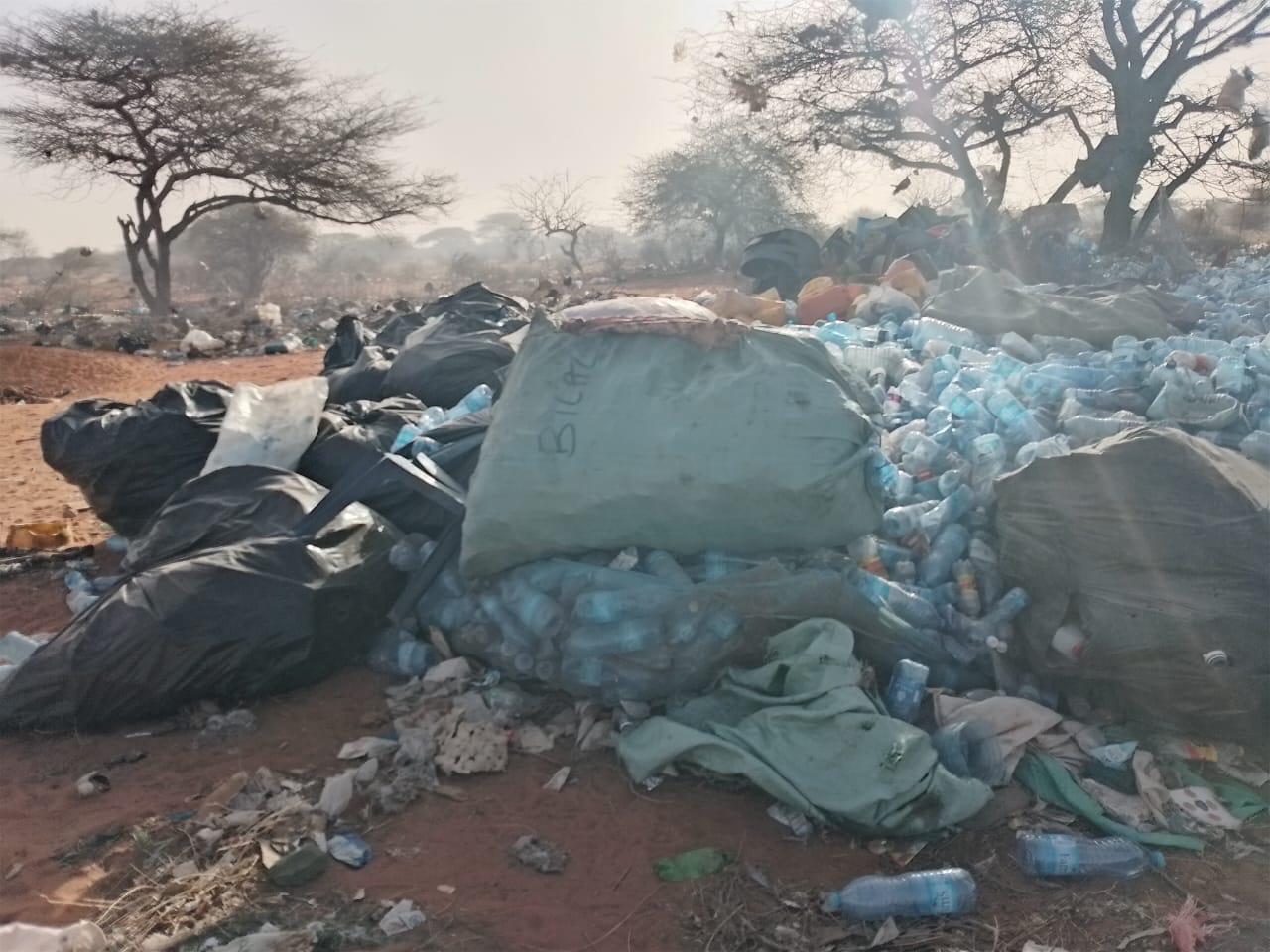
Just a few kilometers from Wajir town a cloud of smoke, a pungent smell and the sight of Marabou storks feeding on waste welcomes you to Ali Maow village. Inside, lies an open land fill, the smoke filling the air bringing with it an invisible threat that residents say had turned life in their village into a health gamble.
For the community in Ali Maow the land fill site is a physical representation of years of neglect, mounting health risks that residents say is a blatant violation of the Bamako Convention and the Kenyan Constitution which guarantees every person’s right to live in a clean environment.
On the 14th of June 2019, Residents of Ali Maow took their grievances to the senate through an official petition calling for an end to ‘the disgraceful abuse of the right to enjoy environmental rights under Article 42 of the Kenyan constitution of Kenya 2010.’ The residents wanted the national government to remove the landfill from their village.
The petition paints a grim picture of unregulated waste dumping, including hazardous materials, at a site never designed to safely handle such waste.
“The government has been using the dumping site illegally to dump raw medical waste. As a matter of good practice and policy, waste should not be dumped near human settlement,” Mr. Abdirashid explains. “It’s been six years since that petition and nothing has been done, the dumpsite is still active and constantly putting the life of residents at risk.”
The Wajir dumping site was established in 1992, when the pollution was low. Nowadays the landfill is full to capacity, spilling over human settlement, mixing with water sources and posing significant health risks to the community.
Wajir, a semi-arid area that is prone to strong dry winds. For the people in Ali Maow this means inhaling smoke and fumes from the landfill. Coupled with the high water table of the region, toxins seep into the water source leaving villagers vulnerable to cholera and other water borne diseases.
“As a result of mismanagement of the waste disposal site water in and around the local community is contaminated, thereby exacerbating the problem even further as pathogens from human wastes have caused numerous cases of hepatitis and cholera as well as diarrhea leading to the deaths of some residents of Ali Maow village who died from hepatitis and cholera,” their petition read in part.
According to the Bamako Convention of which Kenya is a signatory, African countries sought to ban the import and control the transboundary movement and management of hazardous waste within Africa.
The Bamako Convention arose from the failure of the Basel Convention to prohibit trade of hazardous waste to less developed countries especially in Africa.
Executive Director at the Centre for Environment Justice and Development (CEJD), Griffins Ochieng, explains that the Convention was born out of the need by African countries to regulate the import of hazardous waste into Africa.
“Despite the presence of the Basel Convention, Africa still experienced widespread dumping of hazardous material,” Ochieng explained. “That is why African states came together to develop their own convention that would better protect its states.”
As a signatory of the Bamako Convention, Kenya is legally bound to honor all the provisions of the Convention. Under article four of the convention the country is obliged to ensure that the generation of hazardous waste is reduced to a minimum considering social, technological and economic aspects. It also obliges Kenya to ensure the adequate treatment and disposal of hazardous waste in an environmentally sound manner.
But implementation has remained a challenge. In the case of Ali Maow the provisions provided under the convention prohibits the incineration of hazardous waste which is actively happening in the dumping site.
Proper implementation of the Bamako Convention could provide Kenya with a comprehensive framework to address landfill problems like those in Wajir.
The convention requires strict monitoring systems, environmental impact assessments for waste disposal sites, and regular inspections to ensure compliance. By fully adopting these mechanisms, Kenya could establish proper waste segregation facilities, develop safe disposal methods for hazardous materials, and create buffer zones between dumpsites and residential areas.
The convention also mandates public participation in environmental decision-making, which would empower communities like Ali Maow to hold authorities accountable and prevent the establishment of unregulated dumpsites near settlements.
“There are gaps between policy and actual practice regarding hazardous waste management. Kenya has specific laws on management of hazardous waste and solid waste but implementation on the ground remains a challenge.”
According to Mr. Ochieng, the health impacts of informal dumpsites are well documented. “The waste from informal dump sites affect the health of the communities because those waste contain toxic chemicals. They contain many which affect human health and environment, in fact there is documented evidence of how this affects the populations, the communities, including waste pickers, because the exposure to hazardous waste results in many other health poses significant health and developmental impact to people,” Mr. Ochieng noted.
Despite a court order calling for the closure and relocation of the dump site, residents say the landfill is still active. Instead, a wall has been built around the landfill. Residents see the wall as a failure by authorities to fully implement court orders.